Biocompatibility and ISO 10993: What It Means for Medical Tubing
What biocompatibility really requires for medical tubing, how the ISO 10993 framework works, and why material choice and processing both decide whether a tube passes.
Any tube that contacts the body, or the fluids that go into it, has to be biocompatible. It is not enough for the polymer to be strong and dimensionally perfect; it must also be safe for its intended contact. Biocompatibility is where materials science meets regulation, and for medical tubing it usually comes down to one framework: ISO 10993.
What biocompatibility actually means
Biocompatibility is the property of not causing a harmful biological response in its intended use. Crucially, it is not a fixed label on a material — it depends on how and for how long the device contacts the body. The same polymer can be perfectly acceptable for a device that touches intact skin and unacceptable for one implanted for months. Contact type and duration define the testing burden.
How ISO 10993 structures the question
The ISO 10993 series is the internationally recognised framework for evaluating the biological safety of medical devices. Rather than a single test, it is a family of standards that guides a risk-based evaluation. It classifies devices by:
- Nature of contact — surface (skin, mucosa), external communicating (blood path), or implant.
- Duration of contact — limited (up to 24 hours), prolonged (up to 30 days), or long-term (over 30 days).
From that classification, the standard points to which biological endpoints to evaluate — cytotoxicity, sensitisation, irritation, and, for higher-risk contact, systemic effects and more.
The endpoints that come up most for tubing
For typical fluid-path and short-term tubing, three endpoints do most of the work:
- Cytotoxicity — does an extract of the material harm cultured cells? Usually the first screen.
- Sensitisation — can it provoke an allergic response?
- Irritation / intracutaneous reactivity — does it irritate tissue on contact?
Blood-contacting tubing adds haemocompatibility considerations. The higher the risk class, the longer the list.
Why processing matters, not just the polymer
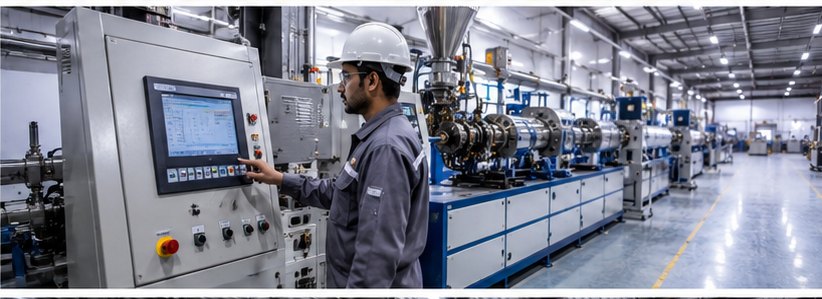
A common misconception is that biocompatibility is decided entirely by the raw resin. In reality, processing can make or break it. Additives, colourants, mould-release agents, inadequate drying, or thermal degradation during extrusion can all introduce substances that show up as extractables and leachables — the chemicals that migrate out of the material into surrounding fluid. A biocompatible resin, badly processed, can fail. This is why clean, well-controlled extrusion on properly maintained medical tubing extrusion lines is part of the biocompatibility story, not separate from it.
Extractables and leachables
Regulators increasingly focus on extractables and leachables (E&L): what can be pulled out of the material under exaggerated conditions (extractables) and what actually migrates during normal use (leachables). For drug-delivery tubing especially, E&L data is central, because a leachable could contaminate the drug. Choosing well-characterised medical-grade compounds and controlling the process to avoid degradation is the practical route to clean E&L results.
What this means when specifying tubing
- Start from the contact type and duration — that sets the testing burden.
- Choose a well-documented medical-grade compound with a known biocompatibility history.
- Insist on clean, controlled processing — drying, no degradation, no stray additives.
- Keep traceability so any finding can be tied back to a lot and a process.
For a broader regulatory view, the US FDA publishes its own guidance on applying ISO 10993 for device evaluation, which is worth reading alongside the standard itself.
The takeaway
Biocompatibility for medical tubing is a risk-based question answered through the ISO 10993 framework, scaled to how and how long the device contacts the body. The material sets the starting point, but processing decides whether that potential is realised — which is why material selection and a clean, controlled extrusion process have to be considered together, not in isolation.