Braid- and Coil-Reinforced Catheter Tubing: How Reinforced Shafts Are Made
Why high-performance catheters embed a metal braid or coil in the tubing wall, how these reinforced shafts are constructed, and what each reinforcement style contributes.
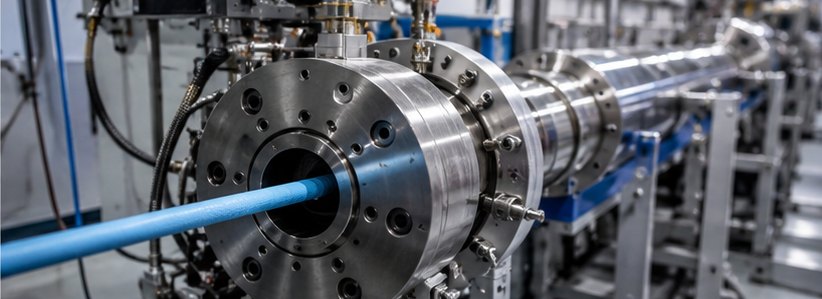
Look inside the wall of a modern guide catheter or microcatheter and you will often find something a plain extruded tube does not have: a fine metal braid or coil embedded between an inner liner and an outer jacket. That reinforcement is what lets a thin, flexible tube be pushed, steered and torqued through the vasculature without kinking or collapsing. This article explains why reinforcement is used and how these composite shafts are built.
Why reinforce a catheter at all?
A useful catheter has to satisfy demands that pull in opposite directions:
- Pushability — force applied at the hub must transmit to the tip.
- Torqueability — twisting the hub should rotate the tip predictably (1:1 is the ideal).
- Flexibility — the tip must be soft enough to follow delicate anatomy.
- Kink resistance — the tube must bend tightly without collapsing its lumen.
A single homogeneous polymer cannot do all four well. Reinforcement decouples them: the polymer provides softness and a smooth lumen, while the embedded metal provides column strength, torque transmission and kink resistance.
The layered construction
A reinforced shaft is fundamentally a sandwich built up in stages:
- Inner liner. Usually a thin PTFE tube, giving a low-friction lumen so devices slide through easily.
- Reinforcement layer. A braid or coil is applied directly over the liner.
- Outer jacket. Polymer (often PEBA, nylon or TPU) is extruded or reflowed over the top, encapsulating the reinforcement and bonding the whole assembly together.
That final jacketing step — melting polymer around the reinforced core so it flows into the braid and fuses to the liner — is where extrusion and thermal process control matter most. The polymer must penetrate the reinforcement without disturbing its geometry, and the wall must stay concentric.
Braid versus coil
The two reinforcement styles behave differently:
Braid — wires woven in a crosshatch pattern (like a Chinese finger trap). Braid excels at torque transmission and gives good overall column strength, which is why guide and diagnostic catheters that need 1:1 rotation are usually braided. The braid density (picks per inch) and wire size tune the balance of stiffness and flexibility.
Coil — a single wire wound like a spring. A coil offers outstanding kink resistance and flexibility while still resisting radial collapse, but transmits torque less well than a braid. Coils suit the most distal, navigation-focused sections where flexibility matters more than rotation.
Some advanced shafts combine both — a braided proximal section for torque transitioning to a coiled distal section for flexibility.
Variable stiffness along the length
Reinforced shafts are usually not uniform. By changing the jacket durometer, the braid pattern, or the reinforcement type along the length, designers create a shaft that is stiff and pushable at the hub and progressively softer toward the tip. This is often combined with tapered or multi-durometer jacketing, so the mechanical transition is smooth rather than stepped.
Why this is demanding to manufacture
Reinforced tubing multiplies the precision requirements of plain tubing:
- The liner, reinforcement and jacket must bond into one void-free wall.
- Concentricity has to be held across a composite, not just a polymer.
- The reflow or over-jacketing thermal profile must melt the polymer into the reinforcement without deforming it.
Achieving that repeatably relies on tightly controlled thermal and dimensional processes — the same discipline that specialist extrusion machinery builders bring to primary tubing, applied to a more complex composite. For the metallurgical side, wire and braid suppliers publish specifications on materials such as stainless steel and nitinol that determine how a reinforcement behaves.
Takeaway
Braid- and coil-reinforced tubing is how a catheter becomes a precision instrument rather than a simple tube: the polymer gives it a smooth, soft body while embedded metal gives it push, torque and kink resistance. Understanding which reinforcement does what — braid for torque, coil for flexibility — is the key to specifying a shaft that behaves the way a clinician expects.