Co-Extrusion and Multi-Layer Medical Tubing Explained
Why medical tubing is often built from more than one layer, how co-extrusion combines materials in a single wall, and where multi-layer construction is used.
Not every property a medical tube needs can be found in a single material. A tube might need a slippery inner surface, a strong middle, and a bondable outer skin — three jobs no one polymer does well. Co-extrusion solves this by building the wall from two or more layers at once, each contributing what it does best. It is one of the most useful techniques in medical tubing, and one of the more demanding to run.
What co-extrusion is
Co-extrusion is the simultaneous extrusion of two or more materials through a single die so they fuse into one multi-layer wall. Instead of one extruder feeding the crosshead, several feed it together, and the die combines their melt streams into concentric layers around the lumen. The result is a single tube whose cross-section is layered like plywood rather than uniform.
Why build tubing in layers
Multi-layer construction lets designers combine properties that would otherwise conflict:
- Low-friction inner layer — a slippery lumen (for example a fluoropolymer skin) so devices or fluids pass easily.
- Structural core — a strong or stiff middle layer that carries the mechanical load.
- Bondable or soft outer layer — a skin chosen so the tube bonds well to hubs and fittings, or feels right against tissue.
Other reasons include adding a barrier layer to block gas or moisture permeation, embedding a coloured stripe layer for identification, or using a tie layer to bond two materials that would not otherwise stick together.
Where multi-layer tubing is used
Layered construction shows up across the device world: catheter shafts with a slick inner liner and a bondable jacket, drug-delivery lines needing a barrier against permeation, and tubing where a soft patient-contact surface hides a stronger core. Anywhere a single material forces a compromise, co-extrusion offers a way out.
Why it is harder to run
Co-extrusion multiplies the control problem. Each layer is a separate melt stream that must arrive at the die at the right temperature, pressure and flow, and the die must combine them without disturbing the layer boundaries. The main challenges are:
- Layer thickness control — each layer’s thickness depends on its extruder’s output; balancing several outputs to hit a target ratio is delicate.
- Layer uniformity — the boundaries must stay concentric and even all the way around, or a thin layer becomes a weak spot.
- Adhesion — incompatible materials need a tie layer, or the layers delaminate.
- Melt matching — polymers with very different melt behaviours are harder to co-extrude cleanly.
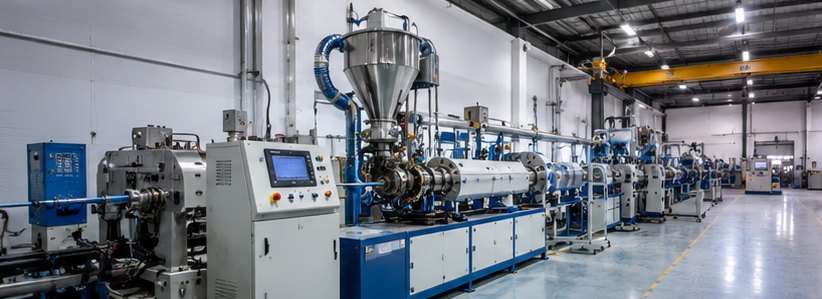
Holding all of that steady across a run depends on stable extruders, precise tooling and continuous measurement — the same precision that a purpose-built medical tubing line brings to single-layer work, applied to a more complex wall. Builders that engineer the extruders, medical tubing crosshead and downstream together tend to handle co-extrusion more reliably than assemblies of mismatched parts.
Tie layers: the quiet enabler
Many useful multi-layer combinations pair materials that do not naturally bond — a fluoropolymer liner with a nylon jacket, for instance. A thin tie layer between them chemically bridges the two, holding the structure together. Much of the art of co-extrusion is selecting the right tie chemistry so the finished tube behaves as one wall rather than layers waiting to separate. For a general grounding in the underlying process, this overview of extrusion is a useful starting point.
The takeaway
Co-extrusion is how medical tubing escapes the limits of any single material, combining a low-friction lumen, a strong core and a bondable skin in one wall. It unlocks designs that would otherwise be impossible, at the cost of a harder process to control — which is exactly why it rewards precise equipment and careful layer management.