Multi-Lumen and Tapered Tubing: The Hard Problems in Medical Extrusion
Multi-lumen, tapered and bump tubing push extrusion to its limits. Here is how each is made, where they are used, and why the tooling and process control get so demanding.
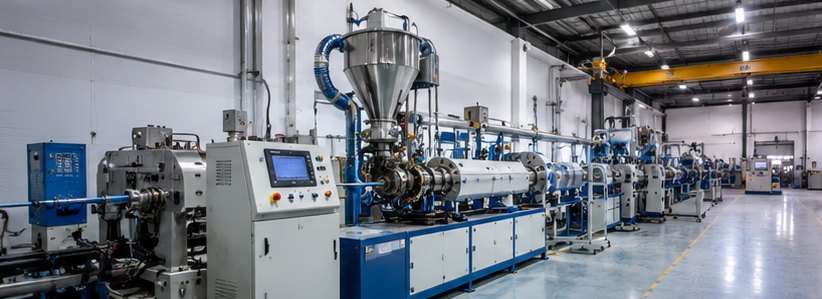
Most medical tubing is a single round lumen with a constant wall — hard enough given the tolerances involved. But a large slice of modern device design depends on tubing that is deliberately not uniform: several channels in one cross-section, or a wall and diameter that change along the length. These are where extrusion engineering earns its reputation.
Multi-lumen tubing
A multi-lumen tube carries two or more separate channels inside a single outer wall. A triple-lumen central venous catheter, for instance, lets clinicians infuse incompatible drugs simultaneously without mixing. Other designs run a working lumen alongside smaller channels for a guidewire, inflation media or sensor wiring.
The challenge is entirely in the tooling and flow balance:
- The die contains a fixed set of pins that form each lumen. Melt must distribute evenly around every pin, or the walls between channels come out uneven.
- Thin septa — the internal walls dividing the lumens — are fragile in the melt and easy to distort. Draw-down has to be tuned so they stay straight and centred.
- Because the pins are held from one side, any pressure imbalance shifts them, throwing off lumen position.
Getting a clean, symmetric multi-lumen cross-section repeatably is a genuine test of both die design and melt stability.
Tapered tubing
A tapered tube changes diameter along its length — larger at one end, tapering smoothly to a smaller distal tip. Catheters use this constantly: a stiffer, larger proximal section for pushability, tapering to a soft, small tip that navigates delicate anatomy.
Tapers are produced on the fly by coordinating three levers in real time as the tube runs:
- Haul-off speed — pulling faster draws the tube down to a smaller diameter.
- Melt output — the screw delivers more or less polymer.
- Vacuum — the sizing trough trims the outer surface.
A controller ramps these together on a programmed profile so the transition is smooth rather than stepped. The precision of the take-off and sizing hardware sets how tight and how repeatable those transitions can be — which is why serious medical work leans on purpose-built extrusion line builders rather than general-purpose tubing equipment.
Bump tubing
Bump tubing is a cousin of the taper: the diameter (or wall) steps up in one or more discrete sections along an otherwise constant tube. Those “bumps” become balloon-bond zones, strain reliefs or transition points once the tube is converted into a finished device. Producing them means executing a controlled diameter change at precise, repeatable intervals — again a matter of programmed haul-off and output control, validated against tight positional tolerances.
Why process control decides everything
Across all three, the common thread is that the geometry is created dynamically and cannot be inspected until it exists. That forces a heavy reliance on:
- Closed-loop measurement. Laser gauges feed diameter back to the line controller continuously.
- Stable melt. A pressure or temperature wobble at the screw shows up directly as a dimensional defect — and in a taper or septum, it is unrecoverable.
- Validated recipes. Once a profile is proven capable, it is locked and traceable, so every metre matches the qualified process.
The bottom line
Multi-lumen, tapered and bump tubing are where medical extrusion stops being a steady-state process and becomes a dynamic, tightly-controlled one. Success depends less on any single clever trick than on the marriage of well-designed tooling with a line stable and responsive enough to execute a changing geometry, metre after metre, within microns. When you see a catheter that smoothly transitions stiffness or carries three isolated channels, you are looking at the output of exactly that discipline.