Medical Tubing Extrusion Trends for 2027: What's Changing and Why
The trends shaping medical tubing extrusion in 2027: DEHP phase-out, the EU PFAS review, multi-layer and co-extruded tubing, micro-extrusion, in-line data and where new lines are being built.
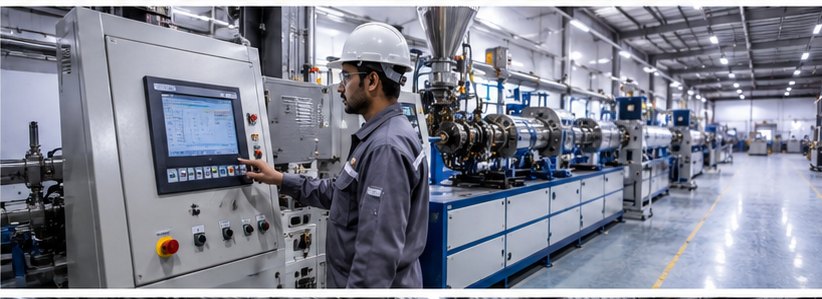
Medical tubing extrusion does not change quickly. Validated processes stay validated for years, and nobody re-qualifies a catheter shaft for fun. But several pressures are building at once going into 2027, mostly regulatory, and they are forcing material changes that ripple through to the lines themselves. Here is what is moving and what it means in practice.
1. DEHP is on a fixed exit path in the EU
DEHP has been the default plasticiser for soft PVC tubing for decades: IV sets, blood lines, feeding and drainage tubing. In the EU it now has a firm end date for medical devices. An amendment to the REACH authorisation list, Regulation (EU) 2023/2482, set the sunset date for DEHP in medical devices at 1 July 2030, with 1 January 2029 as the latest application date for anyone wanting authorisation to continue using it (TÜV Rheinland summary).
2030 sounds distant, but a material change to a device usually means new testing and, under the EU MDR, re-assessment, which takes years. That is why 2027 is when much of the actual conversion work happens. Large suppliers are already moving: Terumo BCT, for example, has said it is converting its PVC tubing sets for EU products to non-DEHP versions (Terumo BCT).
What it means for extrusion: the replacements are either PVC with a different plasticiser (DEHT and TOTM are common choices) or a move away from PVC altogether toward TPEs and polyolefins. Each behaves differently in the extruder, so screws, temperature profiles and sometimes tooling need revisiting. Lines that can run more than one material family are worth more than they were five years ago.
2. The EU PFAS review hangs over fluoropolymer liners
Fluoropolymers such as PTFE and FEP are central to catheter design, mostly as low-friction liners (we cover why in our article on PTFE and FEP liners). The EU’s proposed universal restriction on PFAS would cover them. The assessment is still under way, and while the European Commission has stressed the importance of critical medical applications, no specific exemption for medical devices has been confirmed yet (ECA Academy report).
Nobody expects fluoropolymer liners to disappear in 2027, and most observers expect medical uses to get long transition periods if they are restricted at all. But device makers are already evaluating alternative low-friction constructions, such as lubricious coatings and different liner materials, so they are not caught out. Expect more development work and trial runs in this area.
3. More multi-layer and co-extruded tubing
Co-extrusion lets one tube combine properties no single material provides: a slick inner layer, a strong core and a bondable or soft outer skin. As material rules tighten, it has become a practical way to keep a compliant material in contact with the patient while using something else for strength or barrier properties. Interest in multi-layer and tri-layer tubing is clearly rising. Our guide to co-extrusion and multi-layer medical tubing explains how these lines work and why they are harder to run.
For extrusion shops this means more multi-extruder lines, more emphasis on crosshead design and tie layers, and more demand for layer-thickness measurement.
4. Smaller, thinner, more precise
Neurovascular and structural heart devices keep pushing tubing smaller and walls thinner. Micro-extrusion, where outside diameters are well under a millimetre and wall tolerances are measured in microns, is moving from a specialist niche toward mainstream demand. That puts weight on melt stability, fine take-off control and high-resolution measurement, and it favours small extruders with very steady output over large general-purpose machines.
5. Measurement and data become part of the line
Laser and ultrasonic gauging has been standard on good medical lines for years. What is changing is what happens to the data. Buyers increasingly expect every metre of tubing to be traceable to process settings and material lot, with measurement data logged automatically rather than sampled. Partly that is regulatory pressure on traceability, and partly it is practical: logged data makes validation, deviation investigations and the material re-qualifications described above much faster.
6. More tubing made outside the traditional hubs
Medical tubing has long been concentrated in the US, Western Europe and a few Asian hubs. Supply-chain disruption and cost pressure have encouraged device makers to qualify second sources, and countries such as India are actively encouraging domestic medical device manufacturing through government incentive schemes. That is producing new tubing plants, and with them new buyers for extrusion equipment who are often more price-sensitive than established Western plants. Indian line builders that grew up in wire and cable, Sai Extrumech among them, now also list dedicated medical tubing machines, something that was rare a decade ago.
What to do about it in 2027
- Audit your materials. If you run DEHP-plasticised PVC for the EU market, the conversion timeline is already tight once testing and re-assessment are included.
- Watch the PFAS review. If your devices use fluoropolymer liners, start evaluating alternatives now, even if you never need them.
- Check line flexibility. New or upgraded lines should handle more than one material family and, ideally, more than one layer.
- Plan for data. Make sure measurement data is logged and tied to lots, not just shown on a screen.
- Revisit biocompatibility early. Any material change restarts the conversation about biocompatibility and ISO 10993, and sterilization compatibility needs re-checking too (see how sterilization affects tubing).
The takeaway
The headline trend for 2027 is material change driven by regulation: DEHP leaving EU medical PVC, and fluoropolymers under review. Almost everything else follows from it: more co-extrusion, more flexible lines, more re-validation and a premium on line data. Shops that treat 2027 as the year to re-qualify materials will have a much easier 2029 and 2030 than those that wait.